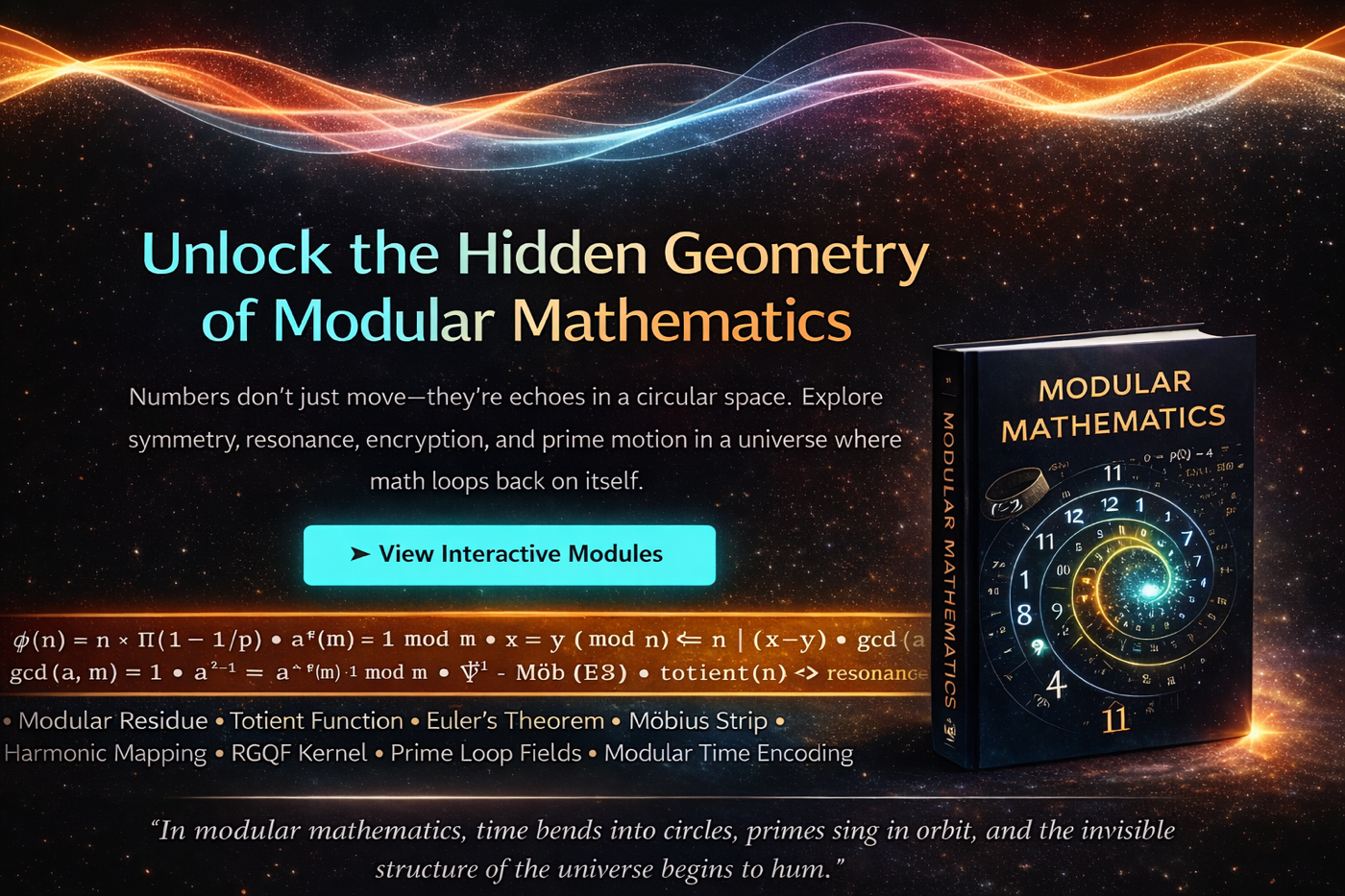
Unlock the Hidden Geometry
of Modular Mathematics
Numbers don’t just move—they resonate. Dive into the cyclical language of primes, patterns, and symmetry where time and space fold through modular logic.
➤ View Interactive Modules
φ(n) = n × ∏(1 − 1/p) • aφ(m) ≡ 1 mod m • x ≡ y (mod n) ⇔ n | (x−y) • gcd(a, m) = 1 • a⁻¹ ≡ aφ(m)−1 mod m • Ψ³¹ · Möb(E₈) • totient(n) ↔ resonance field
Modular Residue • Totient Function • Euler’s Theorem • Möbius Strip • Harmonic Mapping • RGQF Kernel • Prime Loop Fields • Modular Time Encoding
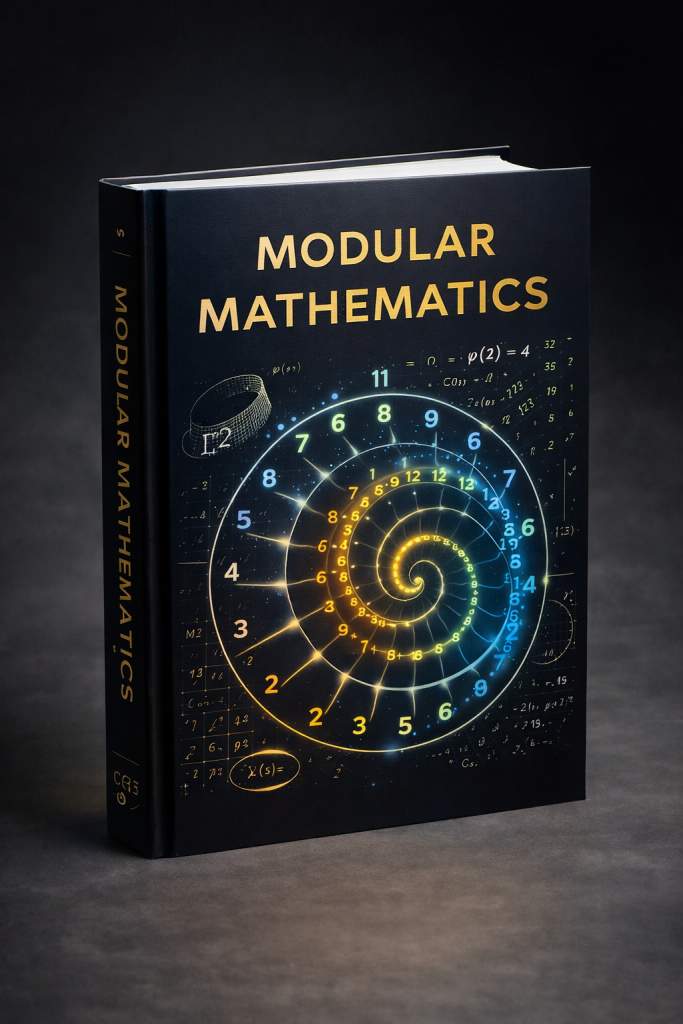
“In modular mathematics, time bends into circles, primes sing in orbit, and the invisible structure of the universe begins to hum.”
🧠 Tap to Learn the Terms
Residue
The residue is the remainder after division…
Modulus
The modulus defines the ring for modular calculations.
Totient
Euler’s totient φ(n) counts integers coprime to n.
Rank
Rank measures dimension or position in modular space.
Order
Order is how often an element cycles back to identity.
Class
A congruence class is a group of numbers sharing a remainder.
Winding Number
Winding number counts how many times a loop wraps a point.
Conformal Mapping
Conformal maps preserve angles in transformations.
Recursive
Recursive definitions use self-reference to build structure.